
You've got all five pieces now: binder, pigment, extender, solvent, additive. This episode puts them into one picture and hands you something you can use the next time a new raw material lands on your bench.
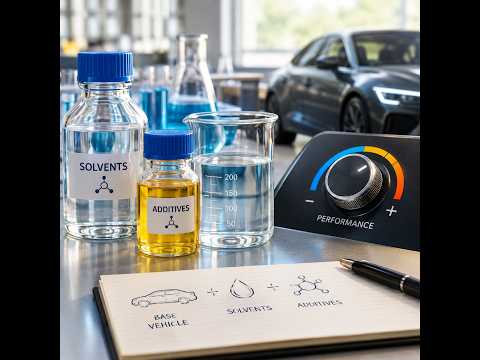
Two ingredients that never show up in the finished film the way a binder or pigment does, and that's exactly why they're the easiest to underestimate. Solvent's whole job is to leave. Additives go in at well under one percent. Get either one wrong and the failure lands right where you can't hide it: the dried film in front of a customer.

A batch comes back from QC: "doesn't hide well." The new tech's first instinct is to dump in more titanium dioxide. That's the formulation equivalent of yelling louder at someone who doesn't speak your language.

You didn't get hired to be a chemist. You got hired to be a really precise baker. The resin makers, pigment producers, and additive houses already did the heavy chemistry. By the time a drum shows up at your dock, the chemistry is baked in. Your job is knowing what each ingredient does, how much to use, and how it behaves alongside everything else in the can. That's a learnable skill, and it's what this part of the series is built around.

We've covered a lot of ground in this series: history, chemistry, regulation, raw materials, lab practice. This episode is about how it all fits together. Not as a list of things to memorize, but as a way of thinking.

Everything so far in this series has been about the chemistry. This one is about the practical reality of working in a coatings lab when you're brand new to it. None of this is in the technical literature. You pick it up from experience, or from somebody who's been around long enough to tell you. Consider this the shortcut.

The global coatings market is worth roughly $200 billion a year, growing 4–5% annually, and it touches nearly every other manufacturing sector — construction, automotive, aerospace, marine, electronics.

By the early 1970s the coatings industry was running well — latex owned architectural, epoxy and polyurethane were established in industrial work, and chromate pigments were the gold standard for anti-corrosion primers. Then the government stepped in, and what followed is the most consequential forced reformulation in this industry's history.

If you work in this industry, there's a good chance everything you touch on a daily basis was developed between 1945 and 1970. That's not an exaggeration — it's the most productive twenty-five years in coatings history. Latex went from a lab curiosity to the dominant architectural coating. Epoxy arrived and transformed industrial coatings. Polyurethane got commercialized. Powder coatings showed up.

Henry Ford did not paint the Model T black because he liked black. He painted it black because carbon black pigment cured faster than any other color, and cure time was the one thing standing between him and a moving assembly line.

A latex wall paint dries. An epoxy floor coating cures. Those are not the same process — and understanding the difference is, without exaggeration, the single most important technical concept in this entire series. In this episode I break down what actually happens at the molecular level when each type of coating "dries," why that distinction predicts almost everything about how a coating performs in the field, and what it means for driers and pot life on the systems you'll actually work with.
